Smart specialization of the regions of the tourist destination is an approach to determining the directions and priorities of development of territories. This regional approach, based on available assets and resources, specific socio-economic challenges, thus reveals the unique opportunities for the region to contribute to the destination’s tourism and hospitality industry.
Such specialization of the region allows to choose the direction for investment. Tourist destination regions should support only a limited number of clearly defined investment priorities. Smart specialization will also help to end the existing destructive competition between the regions, as such specialization emphasizes the characteristics of each community and creates a basis for interregional cooperation and the emergence of joint tourism products.
Specialization means focusing on the specific benefits of the region and the realistic growth potential that can be supported by entrepreneurial activity. Defining specialization (priorities) should be an interactive process, “entrepreneurial search” with the involvement of local businesses and local governments.
This section offers a vision of smart specialization of Saxony-Anhalt regions, which was formed as a result of analysis of statistical data, data on existing manufacture of products and goods in Saxony-Anhalt regions.
Regional planning in Saxony-Anhalt
Usually, the regions carry out their regional planning tasks in regional tourism associations (clusters). These tasks include the preparation, supplementation, and updating of the respective regional development plan and the regional sub-area development plans.
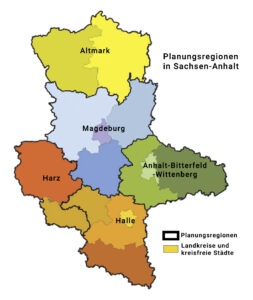 According to the State portal of Saxony-Anhalt, the federal state is divided into five regions:
The Altmark planning region encompasses the Altmarkkreis Salzwedel and Stendal districts. These administrative units together cover a total area of approximately 4,700 square kilometers and have a population of approximately 192,000 (as of 2021).
The Anhalt-Bitterfeld-Wittenberg planning region encompasses the independent city of Dessau-Roßlau and the surrounding districts of Anhalt-Bitterfeld and Wittenberg. The planning region covers an area of approximately 3,600 square kilometers and has a population of almost 359,000 (as of 2021).
The Halle planning region consists of the independent city of Halle (Saale), the Burgenland district, the Saale district, and the Mansfeld-Südharz district (former Mansfelder Land district). The planning region covers an area of just over 3,700 square kilometers and has a population of approximately 679,000 (as of 2021).
The Harz planning region consists of the districts of Harz and Mansfeld-Südharz (former district of Sangerhausen). The planning region has an area of around 2,800 square kilometers and approximately 262,000 inhabitants (as of 2021).
The Magdeburg planning region encompasses the Börde, Jerichower Land, Salzland districts, and the independent city of Magdeburg. The planning region covers an area of approximately 5,500 square kilometers and has a population of just over 681,000 (as of 2021).
Types of tourist regions
According to the classification of Dr. Tetiana Tymoshenko, the territory of Saxony-Anhalt can be divided into “zones” according to the role of tourism/”recreation” in the territorial organization of life:
- Zone with the leading role of tourism
- Zone with the equal role of tourism
- Zone with the auxiliary role of tourism
- Zone where tourism is of no import
By specialization, the regions of Saxony-Anhalt can be divided into 6 categories:
- Tourist city
- Event-festival region
- Ecological region
- Wine region
- Family tourism region
- Territory of production and meeting the needs of the tourism industry (auxiliary region)
Tourist city
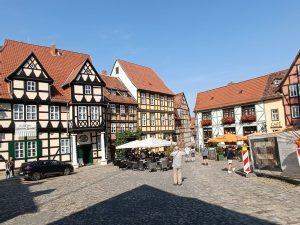
This is the specialization of urban settlements (cities and towns), which have interesting tourist resources that allow you to create short-term cultural and informational tourist products (lasting 2–3 days). The city tourist product provides accommodation in a city establishment of group accommodation or in establishments of individual accommodation.
Such specialization can make an advantage of what is usually considered a disadvantage of the territory. It allows you to use in tourism such objects as large industrial enterprises, sea industrial ports, military facilities etc. For example, the routes of the tourist city of Halle (Saale), in addition to historical sites, may include industrial enterprises and acquaintance with the consequences of the Nazi presence, for example, the so-called Stolpersteine, etc. The specialization of the territory as a tourist city presupposes the presence of a year-round urban tourist product.
For this area specialization, priority products may be weekend tours and conference service (MICE tourism).
The tourist cities of Saxony-Anhalt include such cities as Magdeburg, Halle (Saale), Dessau, Naumburg, Quedlinburg.
Event-festival region
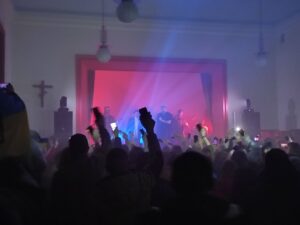 Characteristic features of this specialization are:
- short stay of tourists in the destination (lasting an average of 2–5 days);
- clearly delineated spatial framework (venues of festivals and events);
- specific time frames (dates of events);
- main purpose of the tourist trip is focused on the event.
The event-festival region shall have the following resources:
1) registered, certified areas with appropriate infrastructure (energy communications, transport infrastructure) that provides a high anthropogenic load;
2) utilities and/or other services/organizations that are able to provide appropriate safety and service standards with a significant increase in the load on regular utilities.
This specialization of the region provides a high noise load of events, bright nightlife, active and “loud” visitors. Therefore, the territory of the Event-festival region cannot be combined with the territory of Family tourism region. Tourist products and events in the regions with this specialization: music festivals, sports events, extreme shows, big parties, night events etc.
The event and festival regions in Saxony-Anhalt include most of the Altmark region (Salzwedel) and Magdeburg region (Barockschloss Dornburg, Zerbst, Egelner Mulde).
Ecological region
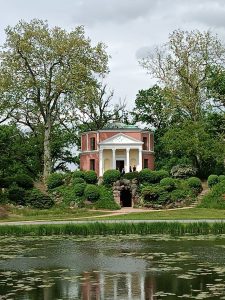 Areas of ecological recreation are regions with little-changed natural areas, non-urban areas with objects of traditional local culture or cultural heritage.
Such areas should have minimally altered natural complexes that have an aesthetic effect and favorable climatic and health conditions. Most tourists visit these areas without an overnight stay, preferring to spend the night in cities and resorts.
Tourist products of the region with this specialization: weekend hikes; active weekends in nature (on foot, on bicycles, kayaks); rural “green”, or agritourism; fitness/his-tours; natural-informational product (observation of flora and fauna); product “gifts of nature” — collecting (not for sale) mushrooms and berries, fishing and hunting.
The territories of ecological recreation of Saxony-Anhalt are represented, first of all, by recreational natural parks UNESCO Global Geopark Harz, Drömling Biosphere Reserve and the Garden Kingdom. They can also include areas of nature reserves and other non-urban areas of the Federal State.
Wine region
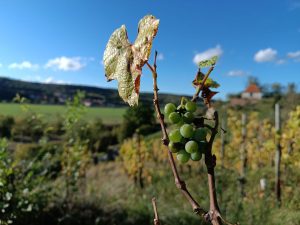 A wine tour is a type of tourist program, the main goal of which is to introduce tourists to the winemaking of Saxony-Anhalt. Such routes are designed for amateurs, both beginners and experienced (and not at all for pompous specialists who can, without blinking an eye, “break down” the contents of a glass into sugars and acids). During the trip, guests get acquainted with the Land’s wine list, enjoy the rural landscapes of wine-growing regions, visit castles and farms, take part in agricultural work (for example, pruning vines or harvesting grapes), inspect wine cellars and taste the drink.
Unlike “city” gastronomic tours, wine programs involve staying in the bosom of nature, in the heart of grape fields. The atmosphere here is rural, both literally and figuratively: early rising, healthy food, working in the fresh air and simple human joys like sitting around a campfire and learning local dances.
Since the program of these tours involves the consumption of alcohol, they are intended exclusively for an adult audience. In Saxony-Anhalt, wine tours can last from 1 to 5 days. The Saale-Unstrut wine region is located in the south of the federal state in the Halle region.
Family tourism region
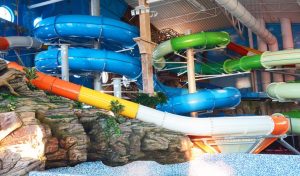 Family and children’s holidays are one of the most stable components of the tourist market of Saxony-Anhalt. However, the organization of such recreation has its own specifics, requires special attention, appropriate zoning and careful preparation of infrastructure.
The territory of family vacation provides both infrastructure for adults with children and the location of children’s camps. These areas are areas of long rest with a stay of more than 8 days. Recreational facilities in such areas are more specific and of great value to certain groups of tourists from urbanized regions of Germany.
Such specialization presupposes the priority of attention to the quality of recreation and health of children, which is manifested in the requirements for the relevant infrastructure, the schedule of tourist facilities, the quality and specification of food, specialized health services.
Infrastructure of the Territory of family vacation includes water parks, playgrounds, children’s pools, equipped children’s beaches, restaurants with children’s menu, etc. Such an area shall meet environmental standards, be free from industrial production, high-risk
facilities (transport interchanges, helipads, energy facilities, etc.). Priority tourist products: children’s and family wellness programs, beach holidays, children’s entertainment programs (camps) etc.
Territories of family rest include the towns of Harz Mountains, lakes (f.e. Beach of Mücheln) and recreational zones of the big cities (Magdeburg, Halle etc.).
Auxiliary region
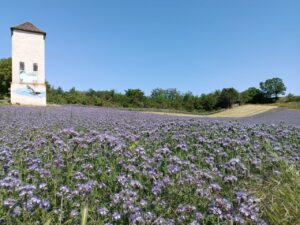 This is the specialization of the urban and rural areas of Saxony-Anhalt, which have the production potential to meet the needs of the tourist flow and the hospitality industry in goods and products. Such areas may not be recreational and may not have attractive tourist facilities. These are areas with agricultural, industrial production and processing, focused on the sale of their products
for the needs of the tourist flow. Such specialization also includes areas with logistics, transport hubs and facilities that ensure the functioning of the region as a tourist destination.
Regions with such specialization make a significant contribution to the value chain of the tourist product, and producers in these regions receive significant added value. Products of the Area of production and needs of the tourism industry: food, groceries, alcohol, furniture for accommodation and other objects of the hospitality industry, linen, farm products, fish and marine aquaculture, souvenirs and other goods.
Auxiliary regions of Saxony-Anhalt include agricultural (non-recreational) areas. An auxiliary region can also be a region located outside the geographical area of Saxony-Anhalt, provided that it participates in marketing and promotion of the destination.
Several categories of smart specialization can be applied
to one region. However, it is required to determine the
ratio of categories in percentage. The final definition of the smart specialization of Saxony-Anhalt regions should be the result of discussions by representatives of local businesses, communities and approved by local governments.
(c) Oleksandr Fainin